Baselayer Half Shorts & Winter Leggings
Preface
As this is a multi-product review, we're not going to provide individual ratings, rather (as we've done in the past) we'll rate the whole ensemble, as some of the products are intended to work in partnership.
The introduction to this piece is quite long and provides a good amount of context for the items reviewed, however for those that want to jump straight into the reviews, click here.
As always, we're looking at each of the products in this review from the point of view of long distance trekking over tough terrain.
Test subject: Chest 42", Waist 33", Height: 5ft 8"
Test items: Saxx Quest, Size = M / Löffler Midway , Size = M / Odlo Active F-Dry, Size = L
Kit Tests: Spring, Summer, Winter
Disclaimer: None required (item not provided by manufacturer)
Summary Datasheet: Weights & Prices (RRP)
Scramble Review
Contents
- Introduction: What do we want and why is it so hard to get?
- - Why Half Shorts?
- - To Be Discontinued: Why Does This Always Happen?
- - Why Are We So "Fixated" On Polypropylene?
- - Why Is It So Hard To Get Polypropylene-Based Half-Shorts?
- 3 Season Half Shorts
- - Overview: Saxx's Quest 2.0 Quick Dry Mesh Boxer (8", Long Leg)
- - Any Negatives?
- 4 Season (Wet / Sub Zero) Half Shorts
- - Overview: Löffler's Midway Transtex Light Boxershorts
- - Any Negatives?
- Sub-Zero Over-Tights / Leggings
- - Overview: Odlo's Active F-Dry Light Baselayer Bottoms
- - Any Negatives?
- Conclusion, Rating & Product Images
Introduction: What do we want and why is it so hard to get?
Walking long distances, whether over flat or mountainous terrain, is a relatively constant affair in terms of energy expenditure when compared to activities like climbing which can be very stop and start. Since ones legs are doing the bulk of the work, they're generating plenty of heat and thus, even in low sub-zero temperatures, we've not found the need for a thermal component for next-to-skin, baselayer bottoms; if it is very cold, just add an over-layer (see Sub-Zero Over-Tights / Leggings).
The purpose of a baselayer is to move moisture and excess heat away from the skin and achieve a thermal balance that doesn't fluctuate too much throughout the day as conditions and activity levels vary. The most important factor when choosing baselayer bottoms is comfort, and that means: a) the avoidance of chafing (low profile seams), b) moisture transport and by extension a hydrophobic, quick drying material, c) breathability, and d) being comfortable when wet, since in certain conditions, no matter how skillful you might be, everything gets wet.
Why Half Shorts?
In our view, the half-leg length is ideal for first layer (next to skin), baselayer bottoms. Form-fitting boxers (6" inner thigh or less) tend to ride up into the groin and 3/4 length tights tend to ride up above the calf, bunch at the back of the knee and want to pull down at the waist when the knee flexes. Conversely, figure-hugging half-shorts stay in place, secure above the knee-cap and below the quads, they tend not to be pulled downward as the knee flexes.
To Be Discontinued: Why Does This Always Happen?
Now, what we're after has already been made. The problem is, it has also stopped being made and a few years back, just as we were about to write our review, the item in question was discontinued. Thank you Spaio!
Italian brand Spaio, who make some high quality baselayers, seem to have decided that half-shorts are for idiots and everyone needs full-length tights. How and why they came to that conclusion, we have no idea. But it's a dumb shame as their Relieve Shorts W04 (pictured below in Black-Red, size Medium) were as close to ideal as we've come across, both in terms of performance and material mix:
- Polypropylene (57%) for its light weight, hydrophobic, thermal, and many other qualities (see below)
- Polyamide (nylon, 37%) to add a little strength and abrasion resistance, and
- Elastane (6%) to provide the necessary stretch for a fitted baselayer.
Here are Spaio's excellent Relieve Shorts W04 and if they were still being made, we'd be recommending them and there would be just two products (Spaio's and Odlo's) in this review, as these function flawlessly in all conditions, in all seasons.
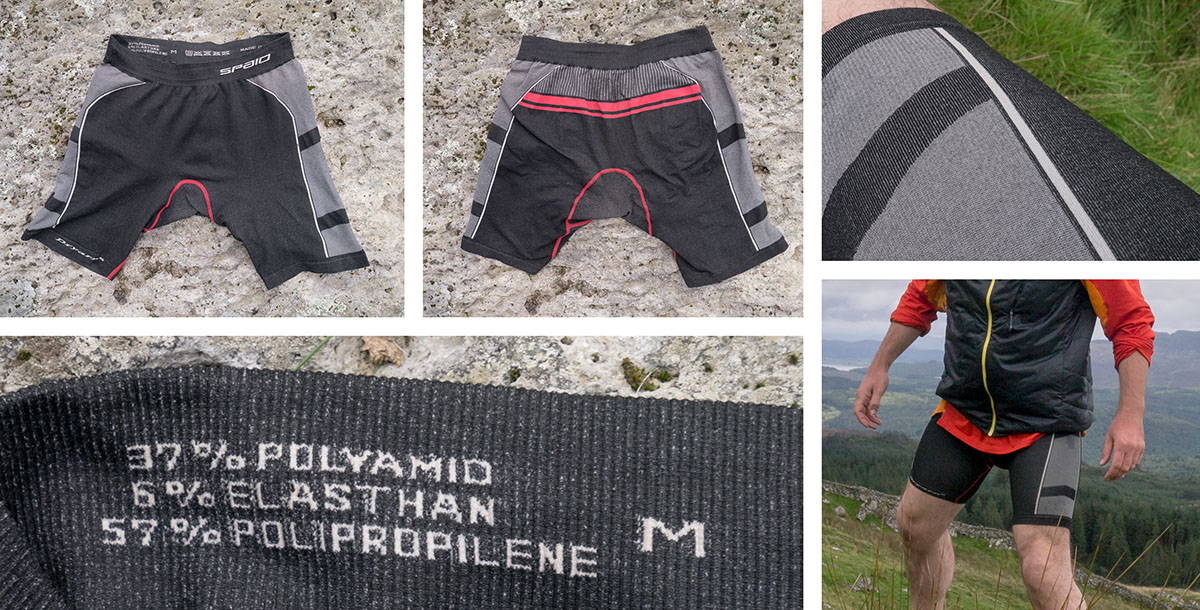 The excellent but discontinued Spaio Relieve Shorts W04.
We're going to be writing to Megmeister to see if they'd like to create something similar as they're ideally positioned to do so. They make two half-shorts already: a compression pair and a padded (chamois) pair for cycling and they're major proponents of polypropylene (PP) which they often refer to by its branded name "Dryarn" (a fine-spun microfibre form of PP).
Megmeister's Drynamo SS Mesh Crew looks to have the right ingredients for a breathable pair of stretchy, mesh half-shorts; being 44% polypropylene, 44% nylon 6.6 (a strong form of nylon) and 12% elastane. It's certainly in the ball-park (partial pun intended).
Why Are We So "Fixated" On Polypropylene?
The reason we're always searching for a dominant polypropylene component in all the baselayers we test is simply because, from the standpoint of a lightweight baselayer, it's hard to envisage a more suitable material:
- Lightweight: Because of its low specific gravity, polypropylene yields the greatest volume of fibre for a given weight. Polypropylene is the lightest of all fibres and is lighter than water. It is 34% lighter than polyester and 20% lighter than nylon.
- Hydrophobic, thus quick to dry: The water absorption of polypropylene fibre is about 0.3% after 24 hours immersion in water, and thus its regain – the amount of water absorbed in a humid atmosphere – is virtually nil (0.05% at 65% RH, 21 °C.). Polypropylene is hydrophobic and will not absorb water in the fibre. Water “wicks” away from the skin and through the fabric to the face for quick evaporation.
- Cold weather performance: Lowest thermal conductivity of any natural or synthetic fibre (6.0 compared to 7.3 for wool, 11.2 for viscose and 17.5 for cotton). Polypropylene fibres retain more heat for a longer period of time providing outstanding insulation and combined with its hydrophobic qualities keeps the wearer dry as well as warm. Polypropylene is warmer than wool, remains flexible at temperatures in the region of -55°C and recovers well from bending.
- Microbially inert: Like other synthetic fibres – nylon, acrylic and polyester – polypropylene fibres are not attacked by bacteria or micro-organisms; they are also moth-proof and rot-proof and are inherently resistant to the growth of mildew and mold.
- Abrasion: The abrasion resistance of polypropylene approaches that of nylon and remains high even when wet.
So, Why Is It So Hard To Get Polypropylene-Based Half-Shorts?
Search Amazon for "Base Layer Half Short Men" and you'll find stacks of products that look like just the thing. On closer inspection, they're either "compression" training shorts (generally nylon or polyester with a very high elastane content - heavy, sweaty and hard to get dry) or they're around 90% polyester and 10% elastane (this kind of thing). They may do a job in ideal conditions, but when it's wet and/or freezing they're exposed for being, to put it politely, non-optimal.
What it tells us however, is that the issue is not the "half-short design" itself; that's ubiquitous. So, it must be something else. Possibly the fact that polypropylene is extremely hard to dye in fabric form? * Or people aren't informed about its properties and so the demand isn't there? Both are possible.
* Polypropylene has a non-polar, highly crystalline aliphatic structure with no active chemical sites that traditional water-based dyes can bond with. Colour is added during manufacturing through a process called solution dyeing (or mass pigmentation) where pigments are mixed into the raw, hot liquid polymer solution before it is extruded through a spinneret to form fibres.
Our view is that the outdoor industry puts shockingly little effort into marketing (or rather, educating people about the empirically proven properties of) the materials they use. An effort that seems inversely proportional to that applied in their often overly-enthusiastic extolling of virtues, far less provable, regarding the performance of their designs. Compounding this is the obfuscatory desire to use all sorts of techy-trademarked names for common materials (Dryarn® instead of polypropylene or Polarloft® which is 3M® Thinsulate® which is polyester), which only serves to confuse the public when it comes to what exactly, in a material sense, they're actually buying.
We recently talked to UK-based brand Sub Zero and they mentioned they've had to halt their polypropylene-based (Meraklon®) product lines, due to problems sourcing the material. Why? We don't know. But it's not good when your name is Sub Zero and you can't use a material that is tailor-made for sub-zero conditions.
We'll leave it there, but all this is a long way to say, that currently finding high quality, polypropylene-dominant, half-shorts is not easy (whatever the reason). Which is why we've been so quiet in this category for so long.
Now, ironically, the first product we're going to look at has no polypropylene in it. We would rather they did, but the Saxx Quest pair performed extremely well and it's only at the extremes that limitations become apparent. As such we recommend these half-shorts, but only for 3-season (i.e. non-perpetually saturated and/or non-sub-zero) use.
3 Season Half Shorts
Saxx's Quest 2.0 Quick Dry Mesh Boxer (8", Long Leg)
Datasheet
| Materials (Main): Nylon / Elastane / Polyester | 77% / 14% / 9% |
| Materials (Pouch Lining): Tencel (Lyocell) / Polyester / Elastane | 64% / 31% / 5% |
| Weight (Size Medium: Stated / Measured) | 90g / 92g |
| Product Sizing Reference: 33" Waist = | Medium |
| Manufacturer RRP | $36.00 (~ £27.00) |
Overview: Saxx's Quest Quick Dry Mesh
The Saxx Quest QD Mesh half shorts (we'll call them the "Quests" from here on) feature the famous "BallPark Pouch" a "3D hammock-shaped" pouch to hold a man's most personal possessions. Having worn many non-pouched, form-fitting pieces like Spaio's Relieve mentioned earlier or F-Lite's Megalight 140s and many others, I was a little skeptical of this "pouch" feature. I'd not, in the past, felt the need to be liberated from my inhibiting half-shorts, indeed when I first tried the Quests on without trousers, I didn't like them.
When it comes to outdoor underpants, there's such a thing as too much freedom and I didn't want my balls bouncing all over the place as I jumped from boulder to boulder. However, the Quests feel completely different "in the field", worn under a pair of softshell trousers.
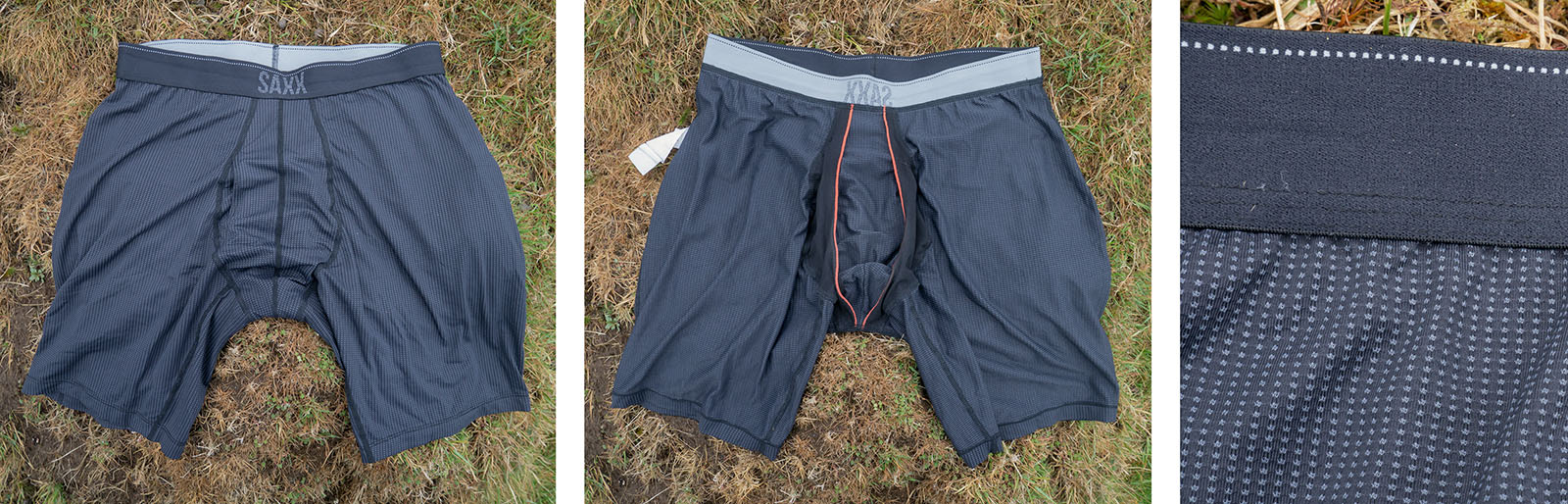 The Saxx Quests are very comfortable and quick to dry (when active).
In use, over the last two wet weather kit test, the Saxx Quests performed admirably; were very comfortable and largely went unnoticed (which is a very good sign):
- Zero seam issues (no chafing).
- They performed perfectly well when soaking wet.
- They dried quickly in active use, though were slower to dry when they got wet in the evenings. I'd set up camp, get the Quests off and hang them out in a cool breeze without much if any sun left, and that's when they struggled to dry out.
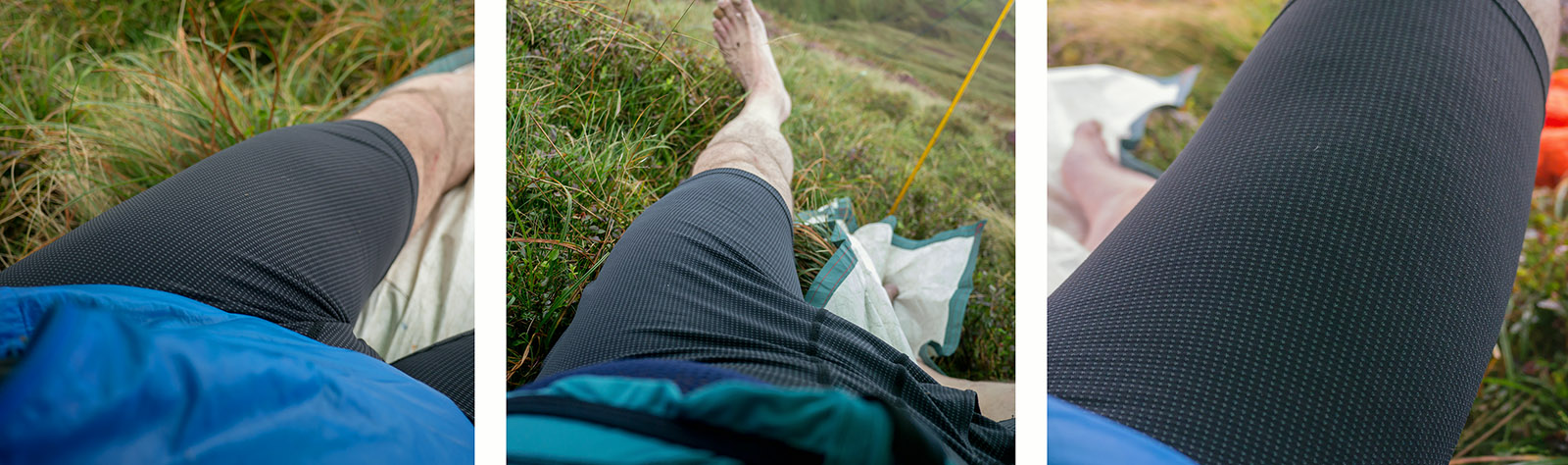
- They have a wide waistband, that doesn't dig into you and has just the right degree of elasticity (pictured above, right).
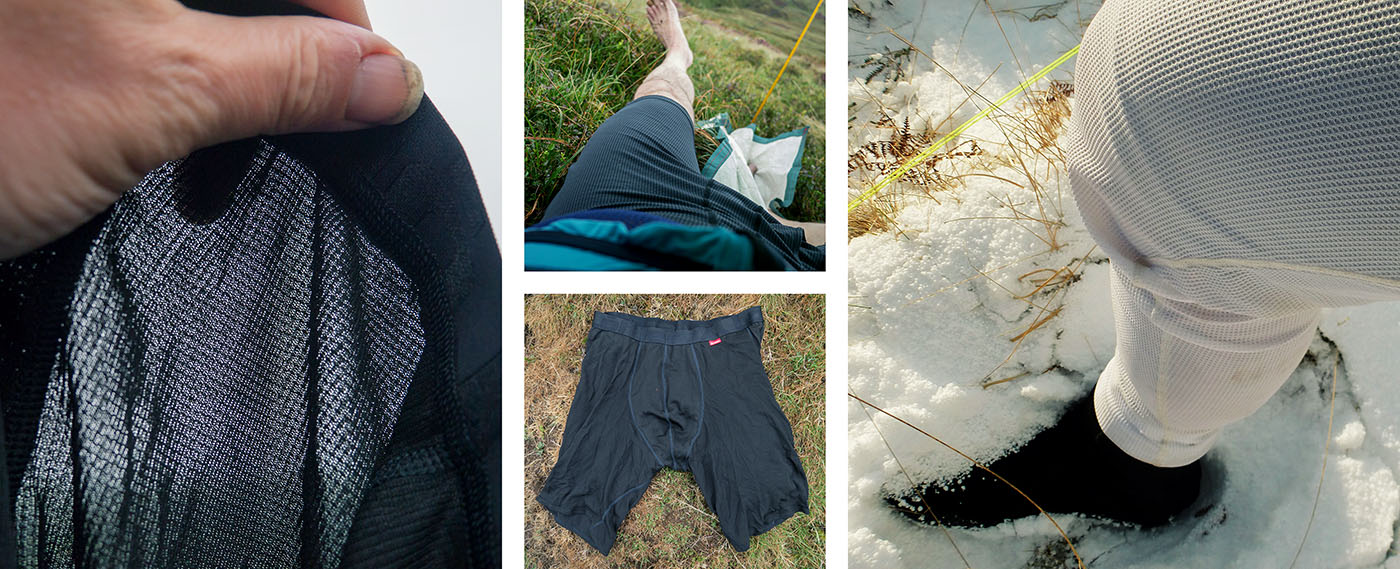
- They never felt clammy, in large part due to the breathable mesh (pictured above, right) which is only really apparent when you hold the Quests up to the light (as per the image below):
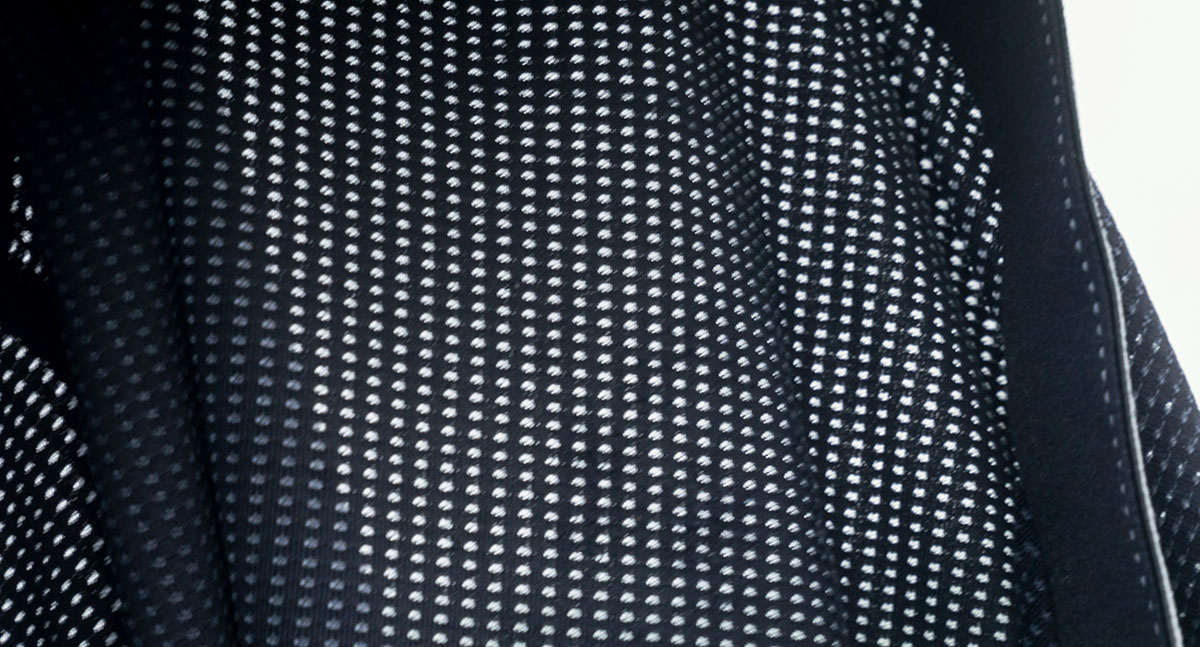 A closer look at the breathable mesh of the Saxx Quests.
Any Negatives? A Brief Summary
We like the Saxx Quest Mesh baselayer bottoms. Shortfalls relate entirely to the material mix Saxx went with. They have quite a lot of elastane (14%) in the mix which obviously provides for a good degree of stretch but it also makes them a little heavier than they need to be. However, it's the nylon and polyester mix which makes them less appealing for sub zero or cold and saturated conditions.
In sub-zero conditions, you need to manage moisture quite vigilantly; it's not fun trying to put on a frozen pair of semi-rigid under-pants. If moist, you need to store them somewhere near a radiator, called "your body". So, you want a material that's as hydrophobic as possible, to repel and/or exorcise water as though it were a demon. The ideal material for this, as we outlined above, is polypropylene.
We only recommend the Quests for temperatures above freezing. When compared to the Löfflers (reviewed below) for regular / 3-season use, the Quests are very much on a par, yet cost about 30% less.
For those that do regularly venture into the freezing cold, we recommend a polypropylene-based pair ... enter Löffler.
4 Season (Saturated / Sub Zero Conditions) Half Shorts
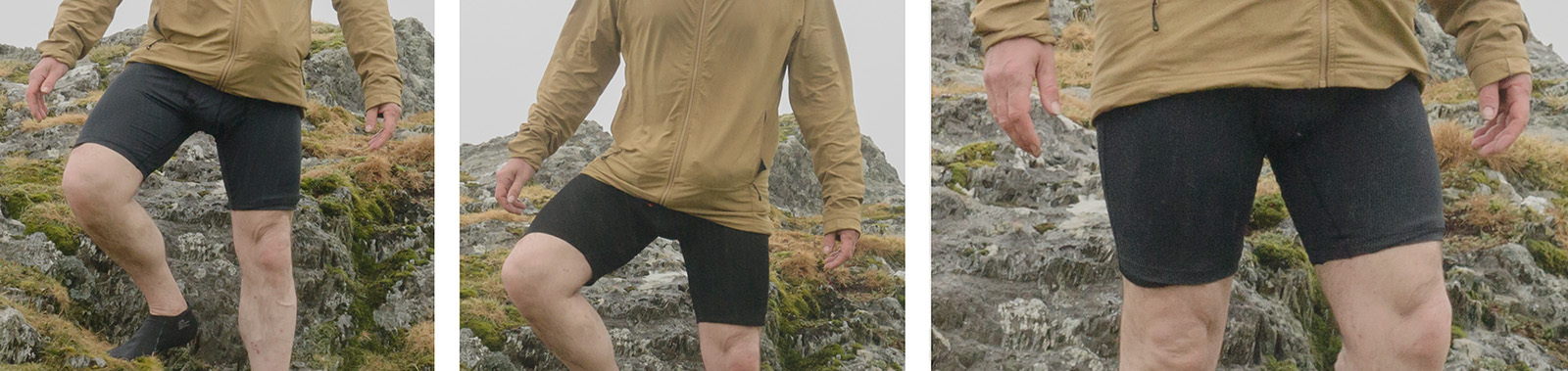
Löffler's Midway Transtex Light Boxershorts
Datasheet
| Materials: Polypropylene / Elastane | 95% / 5% |
| Weight (Size Medium: Stated / Measured) | 60g / 62g |
| Product Sizing Reference: 33" Waist = | Medium |
| Manufacturer RRP | 45 Euros (~ £38.00) |
Overview: Löffler's Midway Transtex
Löffler's Midway Transtex Light Boxershorts (we'll refer to them as the MTLs from now on) are a similar weight (62g) to the ideal Spaio pair (68g) we mentioned earlier and about two thirds of the weight of the Saxx Quests. They're made from 95% polypropylene and 5% elastane, a similar material mix to the excellent (Dry Revolution / Elite 2.0) baselayers Helly Hansen used to produce.
Similar to the Quests, they're made using a fine mesh (finer than the Quests). As we mentioned earlier, polypropylene (PP) has the lowest thermal conductivity of any natural or synthetic fibre and is warmer than wool, so it's best used sparingly in finer gauge applications. If the fabric weight is too heavy (remember PP itself is relatively lightweight), a baselayer may be too warm and cause the wearer to over-heat. The MTL's super-fine mesh is an ideal foundation for a very quick drying pair of baselayer bottoms.
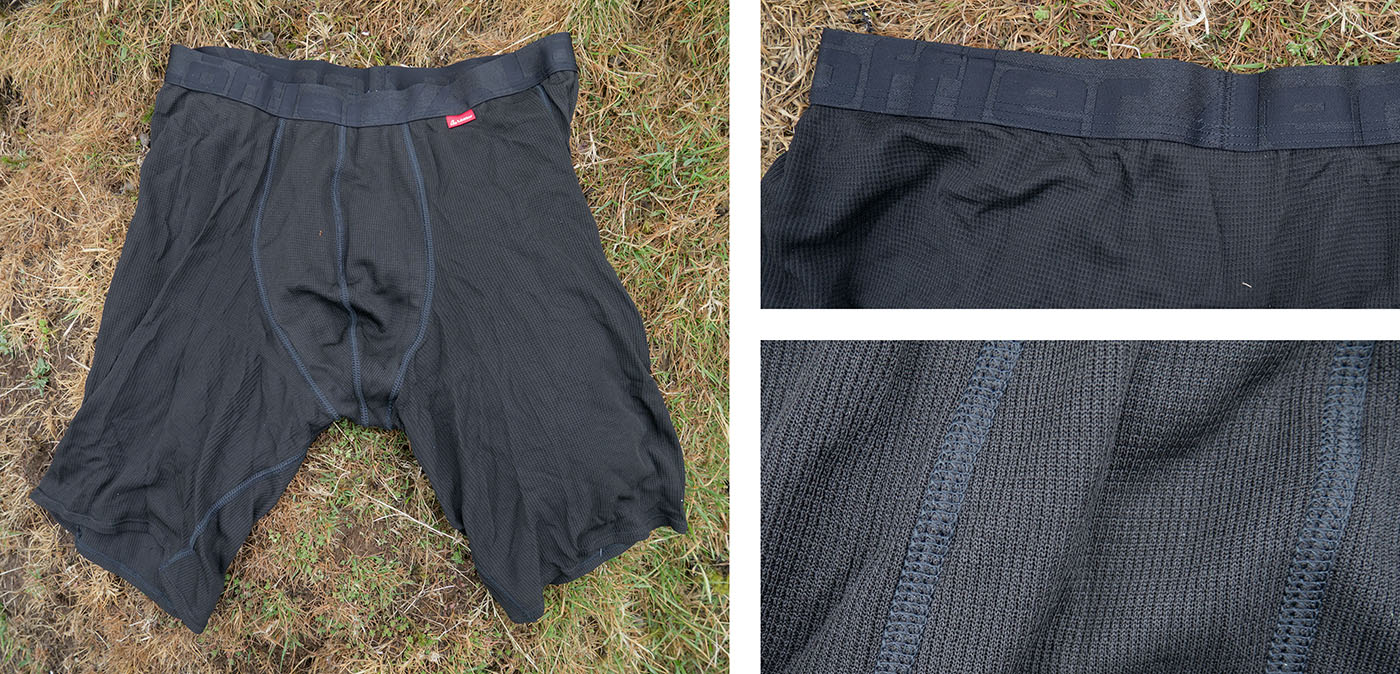 Löffler's Midway Transtex Light Boxers are made from 95% polypropylene.
In terms of design they're quite similar to the Quests, but without the 3D pouch. Like the Quests, in use they were "very comfortable and largely went unnoticed (which is a very good sign)". Performance-wise, there's very little between them, they both do a very good job. The difference is how they handle moisture in more extreme conditions. That's the premium Löffler is making you pay for. In our view, being the kind of people who do wake up in the freezing cold, it's a premium worth paying. If I could choose only one pair and Spaio don't restart production on their Relieve Half Shorts, then I'd go with Löffler's MTLs.
Here's a quick summary of what they have going for them:
- Excellent flat-lock, low profile seams. Zero seam issues (no chafing).
- They performed very well when wet.
- They dried extremely quickly when active and also managed to dry when static overnight. A little airing would get them from damp-wettish to moist and often they'd be dry enough to stow inside my sleeping bag or worst case in my Tower "pillow-setup". Ultimately, polypropylene makes wet-gear management so much easier. It's not that everything is perfectly dry all the time, but there's a big difference getting into slightly moist baselayers and wet baselayers; nothing drains body heat like wet clothing.
- They have a wide waistband, that doesn't dig into you and has just the right degree of elasticity (pictured above, top right).
- They don't get clammy due to the breathable fine-gauge mesh (pictured above, bottom right) which allows moisture to quickly evaporate. The mesh is more apparent when you hold the MTLs up to the light (as per the image below):
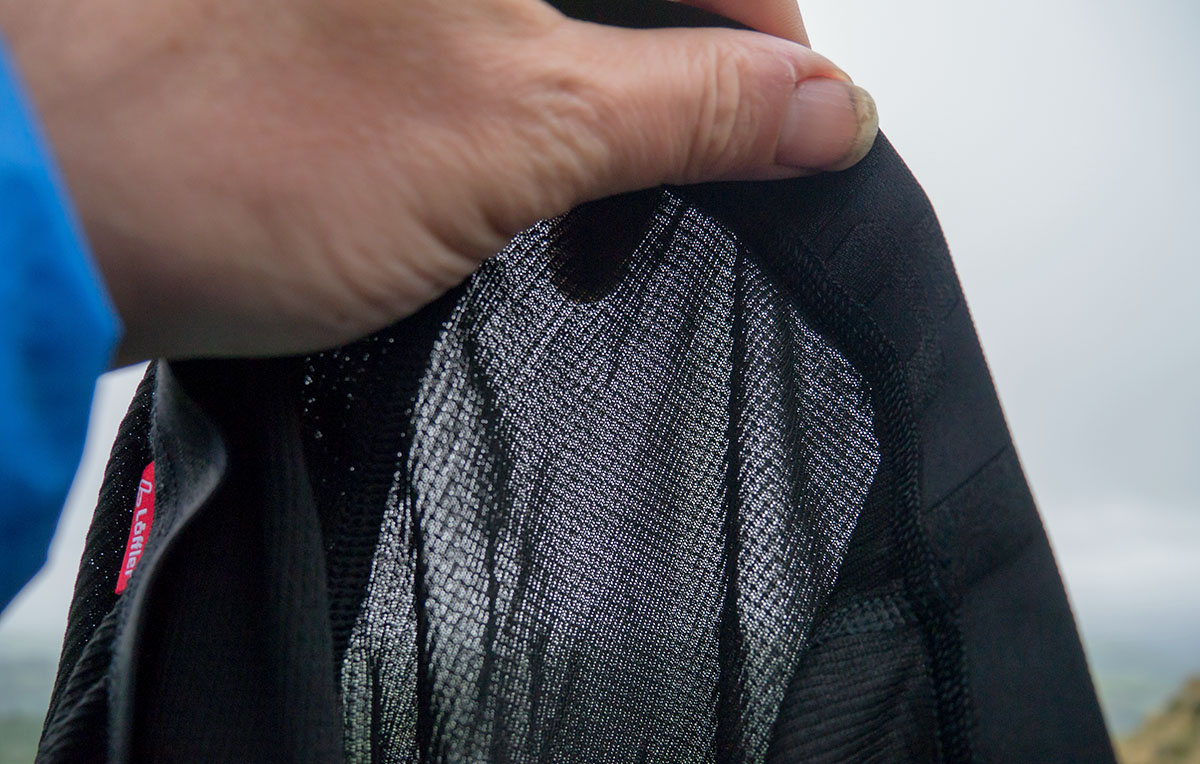 A closer look at the breathable mesh of the Löffler's MTLs.
Any Negatives? A Brief Summary
There are a couple of minor niggles.
They're a fraction shorter than the Quests in the same waist size (medium). We'd like Löffler to add a centimetre or perhaps two to the leg-length.
They're not as easy to come-by as the Quests for UK customers. We contacted Löffler about stocking their MTL half-shorts and they stated they weren't considering supplying UK-based retailers directly. However, many EU stores will ship to the UK and the most UK-friendly in our view is AlpineTrek (who do stock the Loffler MTLs) and reliably ship to the UK (and offer hassle-free returns). They're VAT registered for the UK, so there's no import duty / VAT issues for UK customers (VAT is paid at the point of sale).
We'd love to see more competition in the half-short baselayer arena. Companies like Spaio and Megmeister are ideally suited to manufacture trekking baselayer half shorts with a material mix like that used on the Relieve W04s. An approximate 60 / 32 / 8 mix of polypropylene, nylon 6.6 and elastane with integrated mesh elements would be close to ideal. Nylon 6.6 provides additional toughness and abrasion resistance and elastane yields some stretch and minor compression that makes for a form-hugging half-short.
That, in our view, would be at least the material ingredients for ideal, next to skin, baselayer bottoms We'll leave the design to the pros.
Löffler's Midway Transtex Light Boxershort aren't perfect and they aren't Spaio's Relieve W04s, but they are more than capable; much more. In the kingdom of the blind, the one-eyed man is king. Currently, the world of true, high-performance trekking baselayer half-shorts is a barren and blind kingdom. One we hope is soon to be populated by those who not only look but also see.
Sub-Zero Over-Tights / Leggings
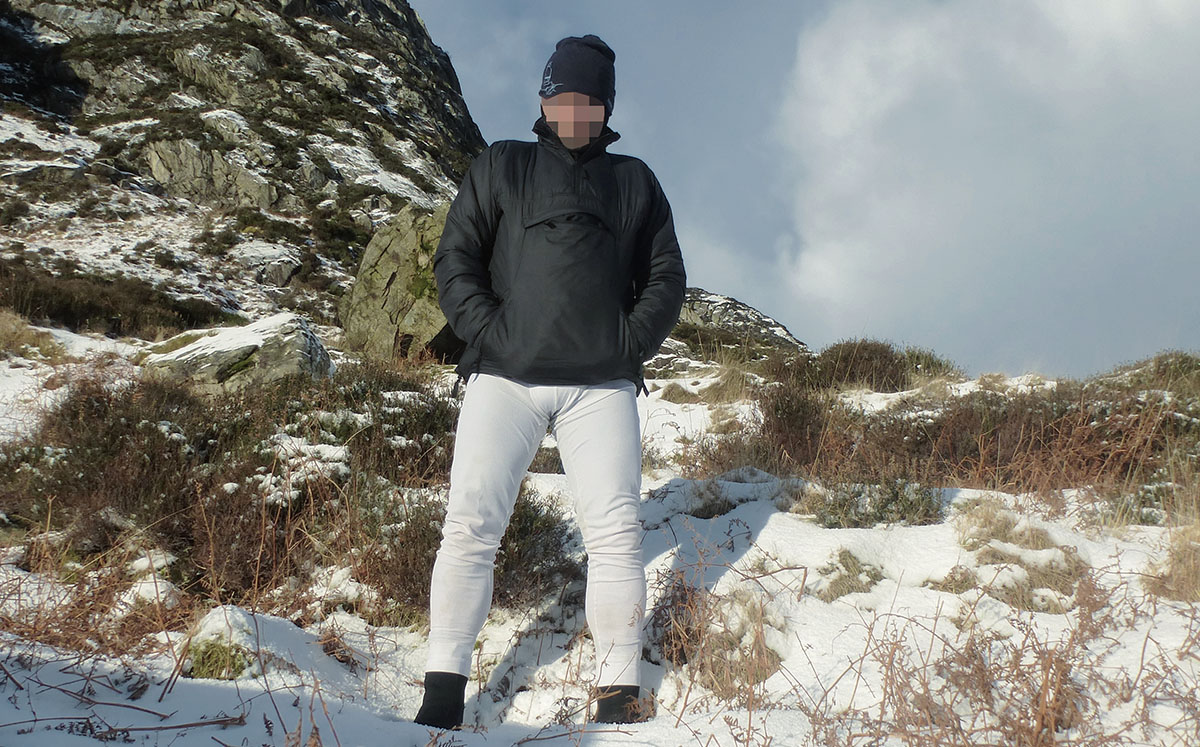
Odlo's Active F-Dry Light Baselayer Bottoms
Datasheet
| Materials: Polyester / Polypropylene | 88% / 12% |
| Weight (Size Large, 3/4 version, measured) | 100g |
| Product Sizing Reference: 33" Waist (fitted / looser as 2nd layer) = | Medium / Large |
| Manufacturer RRP | £45.00 |
Overview: Odlo's Active F-Dry Light
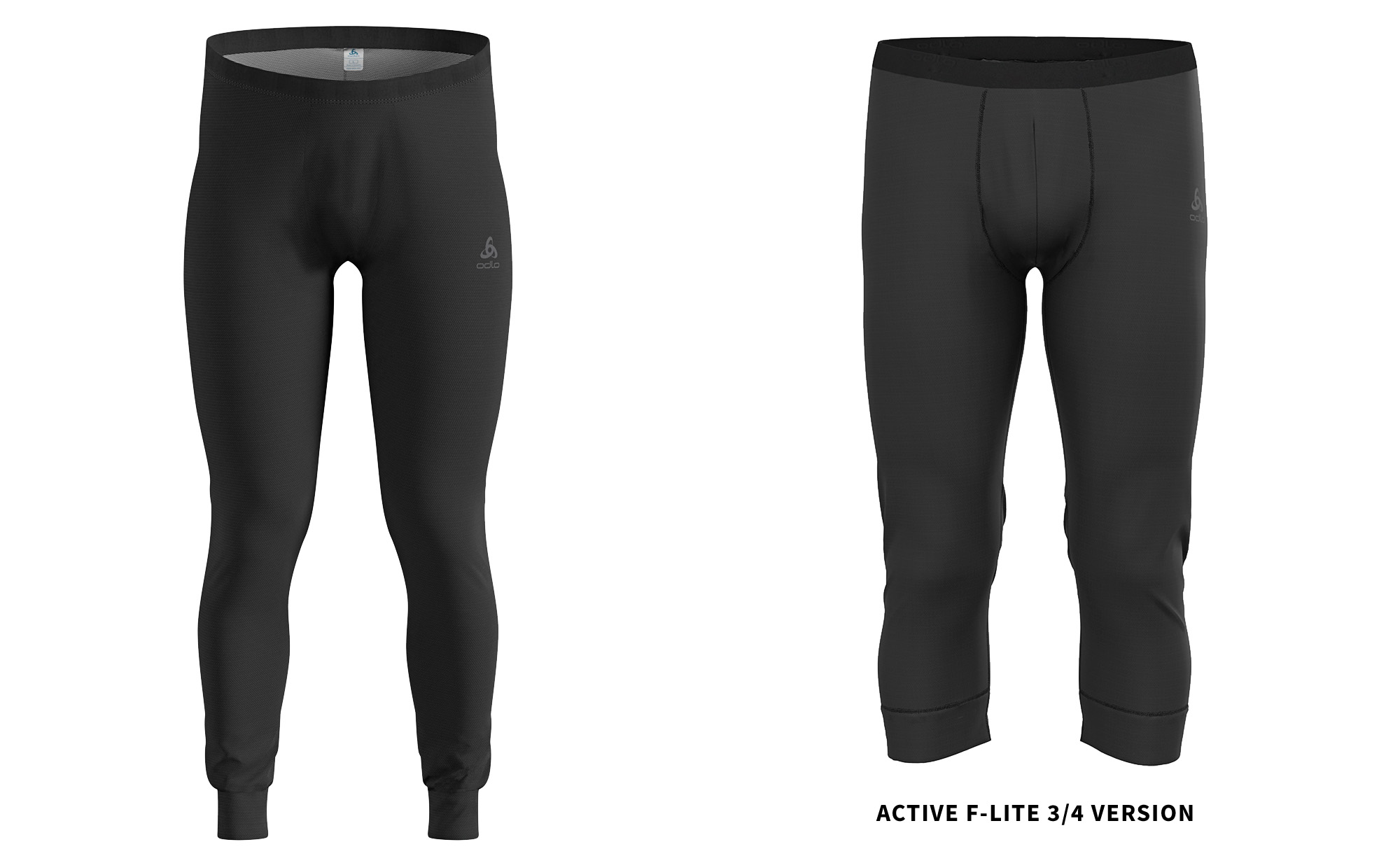
We're going to update this review after the upcoming Winter Kit Test (2026), as the Odlo F-Dry Lights are not the same as the previous Cubics (pictured as placeholders in this review) which the F-Dry Lights replaced. The mesh on the F-Dry is finer and Odlo have added a little (12%) polypropylene to the mix (the Cubics were 100% polyester). This is definitely an improvement. However, the idea is largely the same; a tight mesh of tiny air pockets that provide a breathable and mildly insulating barrier between your legs and the snow-covered or rain-soaked softshell trousers taking the beating above. In short, a comfortable, modular, trouser lining with baselayer properties.
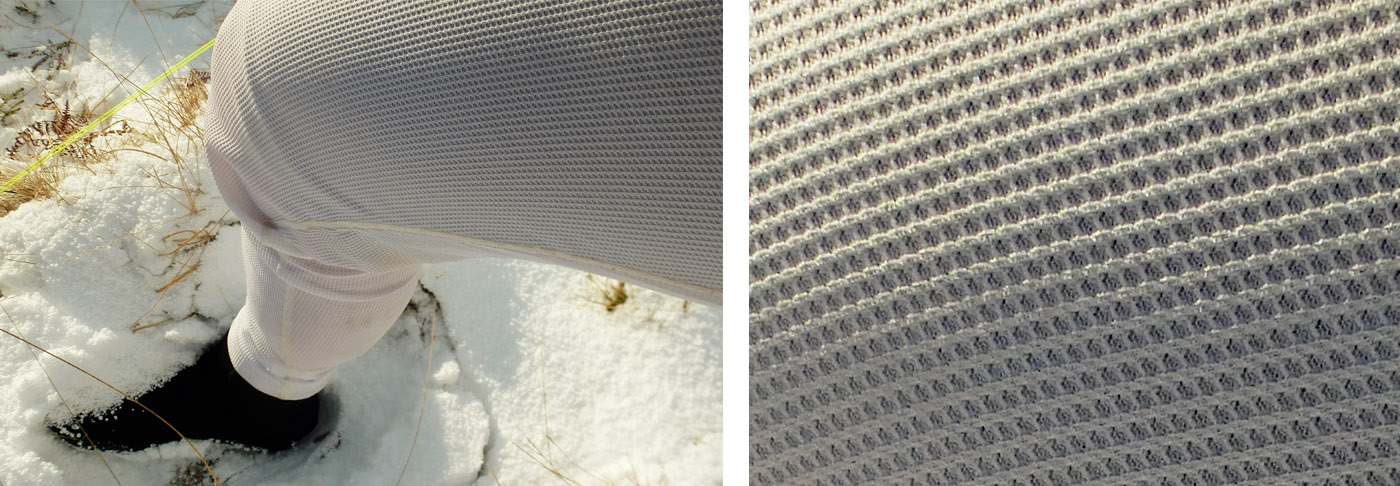 A closer look at the mesh of Odlo's Active F-Dry Lights (pictured are the former version, Odlo's Cubics)
The Odlo Active F-Dry tights lie somewhere between a traditional lightweight baselayer legging and the mesh designs of Brynje. The idea behind the mesh layer is that:
- it's light because much of it is air,
- that air is trapped by other layers and acts as an insulating "air pocket" next to the skin, and
- it's highly breathable, aiding evaporation and thus is quick to dry.
Odlo's Actifve F-Dry baselayers are not a heavy thermal option, but in winter they work extremely well as a 2nd layer over a pair of polypropylene-based half-short like the Löfflers (reviewed above), providing just enough additional protection while guaranteeing the wearer will not overheat, sweat profusely, get wet, then cold.
The Active F-Drys, like the Cubics (L = 115g, full-length) before them, are competitively lightweight (L = 100g for 3/4 length). In terms of sizing, a medium would fit me fine, but we're recommending these for winter use only and sizing up (which doesn't make them a baggy fit) allows one to have them a little higher on the waist, so your baselayer top can be comfortably tucked in between the half shorts and Odlo Active F-Drys. The Odlo 3/4 F-Drys are long enough to tuck under our recommended knee-length winter socks, and this keeps everything in its right place.
The Odlo Active F-Dry full and 3/4 length version both do an excellent job as winter over-tights; a second (intermediate) layer, functioning as modular trouser linings providing a quick drying, breathable and comfortable barrier between your hydrophobic, moisture expelling, half-shorts and your protective softshell trousers.
Any Negatives?
No major negatives to report. We just hope Odlo continue to produce these. If we must be picky, we'd say that Odlo should have added more polypropylene; we'd like to see at least 30%.
We'll update this portion of the review if we have any additional information to add.
Conclusion & Rating
We're not going to make some grand overarching conclusion here, or reiterate conclusions we've already made about the individual products under review. Below, we've rated the three products as one ensemble.
Instead, we'll end this review by saying we're genuinely confused as to why half shorts like those made by Spaio (the Relieve W04) aren't commonplace and standard in the outdoor world. Why Rab, Mountain Equipment, Odlo, Megmeister, Sub Zero, Mammut and on and on, all don't offer some variant of this item (a polypropylene, polyamide, elastane mix half-short with mesh elements) in their trekking baselayer catalogue.
The Spaio Relieves worked across all seasons and ticked all the boxes (set out at the very beginnng of this review) for high performance baselayer bottoms. Yet, finding such a pair, in a domain normally so abundant with options, is like finding a needle in a haystack. How this has become the outdoor world's status quo, we genuinely do not understand. If anyone has any insights, feel free to drop us an email. In the meantime, we're quite happy with the products in this review, we just feel we could be happier.
... and on that note, Happy Christmas everyone!
Product Images
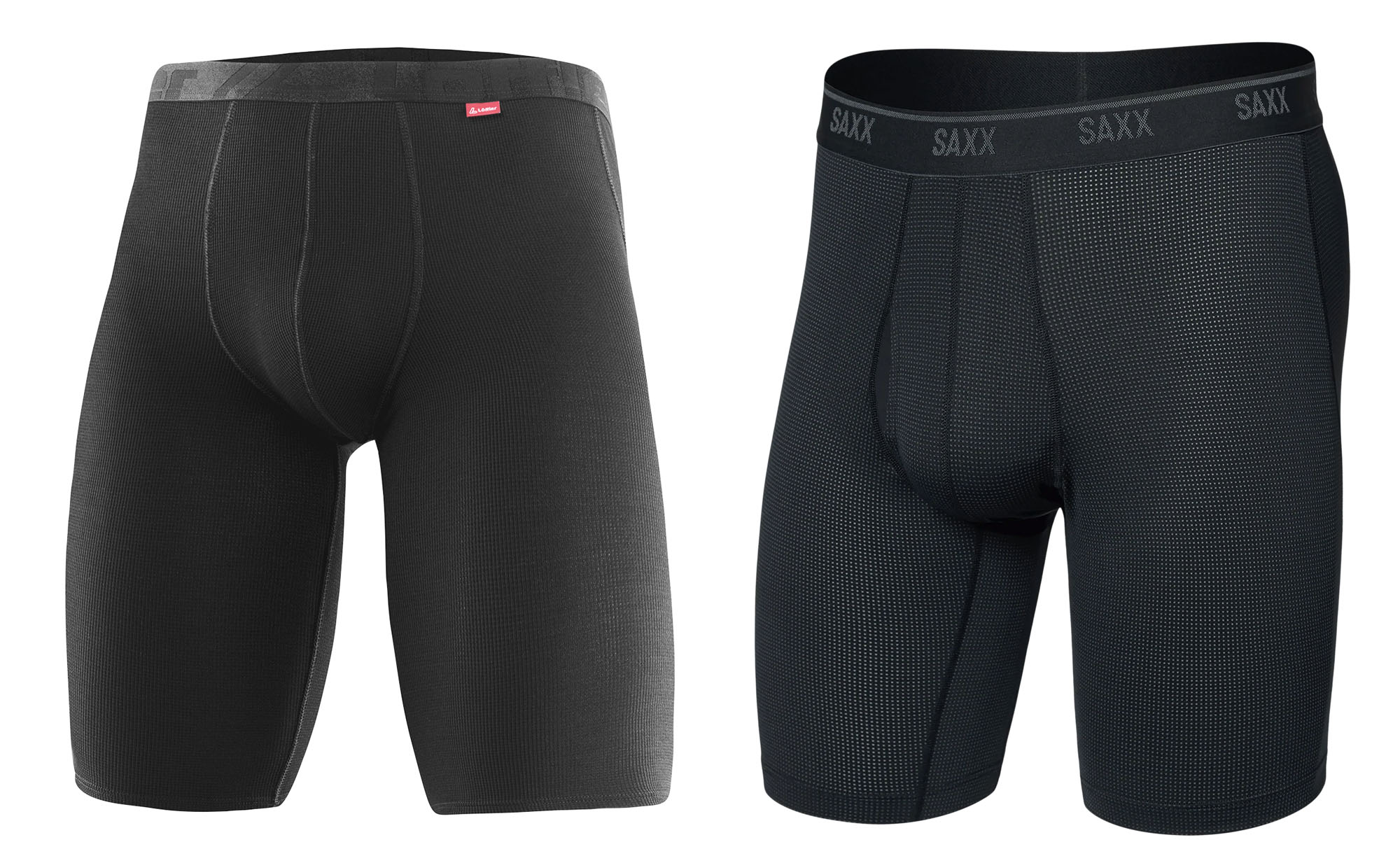
Ensemble Rating (out of 10)
* The value score is derived from two factors:
1) Competitive Market Price (CMP). This represents our judgement of a competitive online price point if we were to stock the item. e.g. if we feel we would need to sell an item at 40% off (i.e. 60% of its full RRP) to be competitive, then our CMP score will be 6/10.
2) Customer Value Price (CVP). We then make an honest appraisal of the maximum price we would be willing to pay for the item (and we're mean). So if we'd pay 80% of its RRP our CVP score would be 8/10.
We then average the two scores to get our final value score, which in our example would be 7/10.
Last Updated: 24/12/25